Posts

Showing posts with the label Origen

Origen of Alexandria: Commentary on Proverbs (Part Two)

Fragments from the Commentary on the Proverbs of Solomon Origen of Alexandria (185-283) Part Two For Part One, see here .  For selections from the Septuagint version of Proverbs, see here .  The source for this selection is PG 13:25D-33D. Crown of graces (Prv 1:9): the enclosure [1] of the virtues, through which they are bound to each other. Golden collar around your neck (Prv 1:9): he calls the surrounding splendor and circular blaze of the divine words “golden collar.”    And he calls the mind “neck.” We will remove his memory from the earth (Prv 1:12): for those who say these things are also those saying: This is the heir; come, let us slay him, so that the inheritance will become ours (Mt 21:38). And cast your lot among yourselves [2] (Prv 1:14): leaving that society, be among yourselves, make the Sabbath among yourselves, prepare the unleavened bread among yourselves, and may you keep the other parts of the law. For they are partakers of slaughter ...
Origen of Alexandria: Commentary on Proverbs (Part One)

Introduction Origen has the dubious claim of both writing theology worthy of a Doctor of the Church and sowing the seeds of the wildest of heresies.  While being perhaps the first to schematically discuss the spiritual senses of Scripture, in the same work (On First Principles), he also theorizes the reincarnation of souls in various lifeforms, from devils, through rocks and animals, to humans, and even to angels, and he preached a final salvation of all souls (apokatastasis panton) , even Satan.  While Origen himself recognized how speculative his theology was and declared that he would fully submit his thought to the corrections of the Magisterium, later thinkers took his oddest speculations and hardened them into heresies.  As a result, when this "Origenism" was condemned, Origen himself--though dead--was condemned as well, and his works were ordered destroyed.  Thankfully, some theologians recognized the abundance of good theology in him, and so they worked to sa...

Sod of the Heart

Image
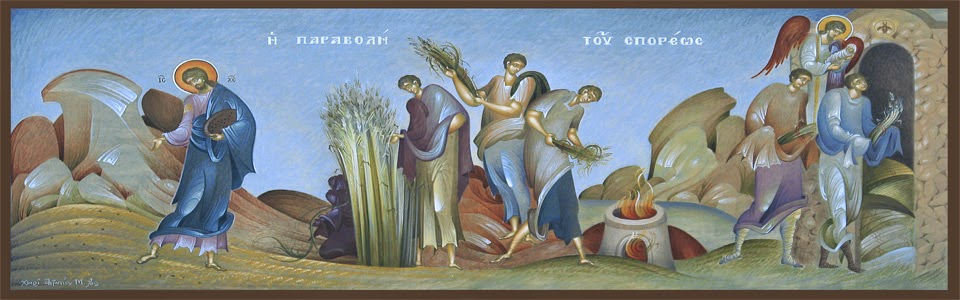
Icon by the hand of Antonios Fikos "And in his sowing, some fell along the road: and the birds came and ate it...[To] all hearing the word of the kingdom and not understanding, the wicked one comes, and snatches what was sown in his heart: this is the one sowed along the road."--Mt 13:4,19 The sowing of the seed in our hearts is not of our doing: what we have control over is what soil we have prepared.  The sower sows freely, and without His sowing our preparation of the soil is ineffective: "How can one believe without hearing?  And how can one hear without a preacher?"  Therefore we must prepare the soil of our hearts well, not letting it become like a road.  Hear what St. Cyril of Alexandria says: "A wayside is almost always hard and unbroken, because it is trodden down by the feet of all those who pass that way, and seed is never sown there.  No sacred or divine word, therefore, will be able to enter those who have minds that are hard and unyield...

The Righteous Rahab

Image
"By faith Rahab the harlot did not perish with the disobedient, receiving the spies with peace."--Heb 11:31 "And in the same way was Rahab the harlot not by works justified, receiving the angels, and by a different way sending them out?"--Jas 2:25 Of the many men and women whose lives we read of in the Old Testament, we account many as models of righteous and early types of Christians.  The Letter to the Hebrews has a long list of them: "By faith a better sacrifice Abel rather than Cain brought to God...," and so it continues through so many figures.  It is easy to see the faith of Abel and Enoch, of Noah and Abraham, of Isaac and Jacob, of Moses and Joshua, of the Judges, of David and Samuel, and so many others.  Yet many, I think, miss the harlot listed among the righteous: Rahab of Jericho. Though we may miss her, the early Church did not.  The author of the Letter to the Hebrews included her among the faithful, and St. James praised her f...

The Innumerable Facets of Scripture

Image
The Holy Prophet Jeremiah  "'Is not My Word like...a hammer that breaketh the rock in pieces?' (Jer 23:29).  As the hammer splits the rock into many splinters, so will a scriptural verse yield many meanings."--Sanhedrin 34A These words of the Jewish Midrash reveal an essential truth: the Light within the Scriptures is unfathomable.  Yet how much more incomprehensible is the fullness of the Lord! So many throughout the Church's life have reiterated the fact that Scripture bears a multitude of meanings.  Origen described three ways of interpreting Scripture: the way of the body, the way of the soul, and the way of the spirit.  In the West, the concept of four senses arose, as a medieval couplet summarizes it: "The Letter speaks of deeds; Allegory to faith; / The Moral how to act; Anagogy our destiny."  Some came to speak of the "sensus plenior," the fuller meaning that lay deeper than the literal meaning of the words themselves.  All t...