Posts

Showing posts with the label St. Ambrose of Milan

Christ the Awaited Man Carries Us to the Baptismal Pool, Troubled by the Spirit

Christ is risen! Today is the Sunday of the Paralytic, when we read the story of the pool of Bethesda, or the "Probatic Pool" (as the Douay-Rheims has it, the pool "by the Sheepgate").  It is an example of Jesus' healing miracles; it is an example of His breaking the Sabbath; it is an example of His mercy for the over-looked.  (It would be easy to read this pericope as a rebuke of "survival of the fittest": the pool only healed the one who got there first, who either was less ill or could hire faster bearers.)  Striking, though, is that odd description of the working of the pool: "For an angel of the Lord, according to season, descended into the pool and troubled the water; then the first one entering after the troubling of the water became healthy from whatever illness he had" (Jn 5:4).  Many early Greek manuscripts omit this verse, and modern translations do as well (as some also do with the stoning of the woman caught in adultery in Jn 8),...
St. Ambrose's Foot-Washing Rebellion

  In English, Holy Thursday is traditionally known as Maundy Thursday , that is “Commandment Thursday” ( maundy coming from the Latin mandatum , “commandment”). For this day is the day that Christ gave His Apostles a commandment, and not just the commandment of the Eucharist, but a commandment of love: “A new commandment I give to you, that you love each other, even as I have loved you” (Jn 13:34). 1 Though this commandment is given later in the Last Supper, as Jesus is beginning His long Johannine discourse, it is typically linked back to the foot-washing at the beginning of John 13, where Jesus similarly declares “If I, therefore, the Lord and master, have washed your feet, you too ought to wash one another’s feet. For I have given you an example so that, just as I have done to you, so you, too, should do” (Jn 13:14-15). So the “Maundy” of Maundy Thursday is taken to mean the commandment of foot-washing, of service, of love, rather than the commandment of the Eucharist....

St. Ambrose: The Power of Fasting

Great is the power of fasting.  Moreover, so beauteous is its bravery that fasting delights even Christ: so strong, that it leads men to heaven.  And, to use human rather than divine examples,  a voice sent forth from the mouth of the fasting Elijah closed heaven, due to the sacrilege of the people of the Jews (1 Kgs 17:1).  So, too, when an altar to an idol was set up by King Ahab (1 Kgs 16:32), at the word of the prophet, for three years and six months, the dew of rain did not fall upon the earth.   A worthy punishment which fittingly restrains intemperance: that heaven would be closed to the impious who polluted earthly things.   Worthy, indeed, that, at the condemnation of the king’s sacrilege, the prophet was sent to the widow in Sarepta of Sidon,  who, since she offered devotion through food, merited that she alone would not feel the distress of the public aridity.   Therefore, the jug of barley did not lack, when the torrent’s flows we...

The Levites' Portion

Image
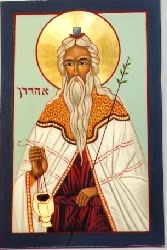
  Holy Prophet Aaron the High Priest "Then the Lord said to Aaron, 'And behold, I have given you whatever is kept of the offerings made to me, all the consecrated things of the people of Israel; I have given them to you as a portion, and to your sons as a perpetual due."--Num 18:8 Out of the twelve tribes of the Israel, the descendants of the sons of Jacob, the Lord chose one to be His own.  For He said, "The Levites shall be mine: I am the Lord" (Num 3:44).  Levi was not among the msot beloved sons of Israel, for of him and his brother Simeon his father said, "Weapons of violence are their swords.  O my soul, come not into their council; O my spirit, be not joined to their company; for in their anger they slay men...I will divide them in Jacob and scatter them in Israel" (Gen 49:5-7).  Yet despite the violent nature of Levi, his descendants were not always so.  While Moses may have been a man of anger at times, Aaron was the servant of God ...

"Guide Me in the Way Everlasting"

Image
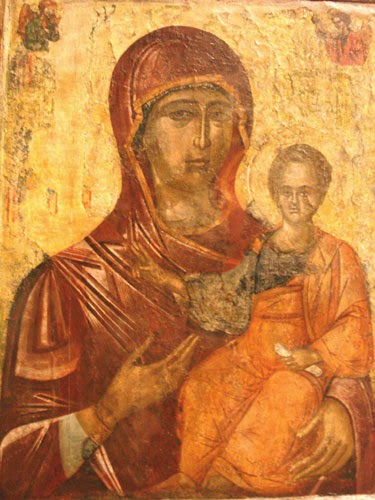
  A Hodigitria Icon, an icon of She Who Guides, from the National Museum of Art in Bucharest, Romania "And see if a lawless way is in me, and guide me in the way everlasting."--Ps 138:24 The way of the Lord is an everlasting way, for He is everlasting, and if we hope in Him, we too shall become everlasting, for we shall have no end to joy.  If we trust in the Lord, an eternal Heaven awaits us, the eternal liturgy where men of all tribes and tongues and races and nations will praise the Lord unceasingly.  The way to this eternal liturgical rest is what we ask from the Lord in this psalm. We ask Him to lead us in the way everlasting (בְּדֶרֶךְ עוֹלָם), a way proportional in length to his everlasting mercy and loving-kindness, "for to eternity is His mercy" (כִּי לְעוֹלָם חַסְדּוֹ).  His mercy is to the ages (εἰς τὸν αἰῶνα τὸ ἔλεος αὐτοῦ), and so He leads us on the way of the ages (ἐν ὀδῷ αἰωνίᾳ).  Thus His mercy accompanies us along our way, our way whi...

Upon Moses' Chair

Image
A replica of the Chair of Moses found at the Synagogue in Chorazin "Upon Moses' chair sit the scribes and the Pharisees: all things whatsoever they tell you to keep, keep and do: but their works do not do, for they speak and do not do."--Mt 23:2-3 How great was Moses' authority, that even his chair continues to be reverenced millennia after his falling asleep!  God ordained him to be the lawgiver of the Israelites and to guide them in the commandments of the Lord, and his authority succeeded him throughout the ages.  First it passed to Joshua, the prototype of Christ in name, then to the many judges the Lord raised, then to the kings of Israel and Judah through the mediation of Samuel, and then to the elders and the teachers after the Exile.  Jesus Himself affirmed this succession of authority, for He affirmed that even the hypocritical scribes and Pharisees had an authority to be heeded.  If even they, successors of the prophet and lawgiver Moses, were to...

The Fruits of Repentance

Image
Jesus Curses the Fig Tree (1684) by Ilyas Basim Khuri Bazzi Rahib "O faithful let us fear the punishment of the fig tree which was dried up for not having borne any fruit; let us offer worthy fruits of repentance to Christ, who grant us His great mercy." --From the Aposticha of Bridegroom Matins on Great and Holy Monday When Christ hungered and approached the fig tree, He expected it to be bearing fruit; when it was not, He cursed it.  Just so, the foolish virgins not possessing oil were barred from the feast.  It is as if Christ said to them as He said to the high priests and the presbyters of the people, "For this I say to you that will be taken from you the kingdom of God, and it will be given to a nation producing the fruits of it."  This too will occur to us if we are not watchful, if we are not prepared in a wedding garment when the Lord comes to invite us into His bridal chamber engulfed in light.  Let us beg Him, "Fill the garment of my...

The Answer of the Tongue

Image
Holy Prophet King Solomon, traditional author of Proverbs "To man are the preparations of the heart: from the Lord is the answer of the tongue." --Prv 16:1 The Lord holds sway over all: with Him is all power, and for this we call Him Pantokrator, All-Mighty.  Heaven and earth and all their inhabitants are under His command, for "the earth is the Lord's and the fullness thereof, the world and those who dwell therein," and "He stretches forth the heavens like a tent," a tent which He can set up and take down at will.  If He wills, He could wipe out man from the face of the earth, as in the time of Noah, yet instead He wills that we work out our salvation in fear and trembling in this world.  Though He does not use His power in its most sweeping way, He still has all power over all created things, down to the smallest speck, and He watches over all and cares for all, as He even numbers each hair on our heads.  Thus He has rule even over the...