Posts

Showing posts with the label St. Augustine

The Many-Lighted Stars of Vocation

 Introduction In keeping with today's Roman Catholic reading regarding the various gifts given by the Spirit for varied tasks (1 Cor 12), I decided to post this little essay I wrote back in 2015, about the variety of vocations.  I may have gone a bit overboard in my quotations, and perhaps the style and precise formulations are not how I would word them now, but, overall, I think it's still a decent piece of writing. The Many-Lighted Stars of Vocation “One [is the] glory of [the] sun, and another [the] glory of [the] moon, and another [the] glory of [the] stars: therefore star differs from star in glory” (1 Cor 15:41).  Each of these has its own role, and usurping another’s role leads to chaos.  So if the sun were the moon, the earth would be consumed like a dry leaf in a bonfire; if the moon were the sun, the earth would be frozen.  Even having any other star replace the sun could have disastrous results: the star could be too large and engulf the solar system,...
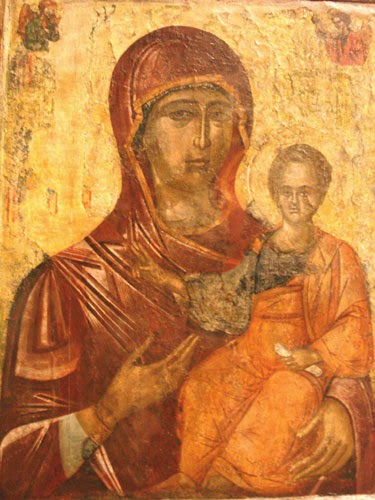
"Guide Me in the Way Everlasting"

Image
  A Hodigitria Icon, an icon of She Who Guides, from the National Museum of Art in Bucharest, Romania "And see if a lawless way is in me, and guide me in the way everlasting."--Ps 138:24 The way of the Lord is an everlasting way, for He is everlasting, and if we hope in Him, we too shall become everlasting, for we shall have no end to joy.  If we trust in the Lord, an eternal Heaven awaits us, the eternal liturgy where men of all tribes and tongues and races and nations will praise the Lord unceasingly.  The way to this eternal liturgical rest is what we ask from the Lord in this psalm. We ask Him to lead us in the way everlasting (בְּדֶרֶךְ עוֹלָם), a way proportional in length to his everlasting mercy and loving-kindness, "for to eternity is His mercy" (כִּי לְעוֹלָם חַסְדּוֹ).  His mercy is to the ages (εἰς τὸν αἰῶνα τὸ ἔλεος αὐτοῦ), and so He leads us on the way of the ages (ἐν ὀδῷ αἰωνίᾳ).  Thus His mercy accompanies us along our way, our way whi...

Married Priests

Image
  Fr. Wissam Akiki greets his wife, Manal, following his ordination on February 27, 2014. "The Lord confirmed that marriage is something of value…because he attended a wedding," as St. Augustine remarked, yet St. Paul declares, "It is well for a man not to touch a woman," and he comments, "I wish that all were as I myself am," that is, without a wife. The value of both marriage and celibacy has always been a part of Christian teaching, since Jesus Himself, who both announced the indissolubility of marriage and proclaimed that marriage will not be in Heaven. The way these two vocations interact with the separate vocation to priesthood has changed over the centuries and is dependent on circumstances.  First, a basic teaching of the Church must be repeated: "Perfect and perpetual continence...is not demanded of the priesthood by its nature" (Second Vatican Council, Presbyterorum Ordinis §16). Just as the old priesthood of the order ...

The Exceeding Beauty of Creation

Image
"And God saw everything, which He made, and behold! it was beautiful exceedingly."--Gen 1:31 Tradition lends a new dimension to the Faith which can easily be missed.  Think, for example, of the account of creation in Genesis, in which each day it is repeated: "And God saw, that it was good."  A quick comparison of English Bible translations shows how ubiquitous the use of the word "good" is in these passages, with only one rebel saying "He was pleased" instead.  Even the Vulgate speaks of how God's creation is "bona."  These all translate well the Hebrew טוב, "pleasing, good, agreeable."  Yet Tradition gives us a rich nuance which should not be avoided. The first line of this post is a translation from the Septuagint, the Greek translation of the Scriptures, according to tradition a miraculous translation, of which St. Augustine said, "the same Spirit that was in the prophets when they spoke was present al...

On Ps 109:7: "He will drink from the brook by the way..."

My wife and I were praying the Hours recently, and the reading of Psalm 109 (110) was proscribed.  "The Lord says to my lord: 'Sit at my right hand...'"  The light of grace has made it abundantly clear to Christians of all times, beginning with the Apostles and Evangelists themselves, that this psalm relates to Christ's "Divine Begetting from the Father and His coming in the flesh" (St. Athanasius).  Thus its announcement of Jesus the Messiah is quoted frequently in the New Testament.  With the light of the Spirit, the key message of most of the verses of this psalm are clearly evident, yet the last line is still "deeply enigmatic," as Pope Benedict XVI admitted.  My wife encountered this enigma and asked me for clarification on this text. "He will drink from the brook by the way; therefore he will lift up his head."  These words come following the description of Jesus' victorious kingship, how He executes judgment and shatters...

On the Conspicuousness of Christians

Image
I was recently instructed that, as a catechist, I should blend myself into my students, to make myself one of them, in order to make them accept me.  If I was too "different" or too blatant in my Catholicism, I would not be accepted.  Instead, I should work from within them, almost in an undercover way.  The thing is, it is difficult to be undercover when your students know you are teaching them the faith.  I can understand my professor's point: the members of the Church should integrate themselves into society so they can change it from within.  It is not an outside force that will bring change, but a force hidden within, such as hidden yeast leavens dough.  We are to be Trojan horses: we must sneak under their radar and then slowly purify their drinking water with the nectar of the faith.  The problem is this: I do not see this as an effective method. I apologize if I am being proud: I am just giving my opinion on an issue that directly affects h...

Litany for Persecutors

Image
I vilify persecutors.  I must admit that this is a habit I have, and one that I have trouble breaking.  When I hear of Kathleen Sebellius and the HHS contraceptive mandate, I vilify Ms. Sebelllius.  When I hear of attacks on Nigerian Christians by Boko Haram, I vilify militant Muslims.  Now, I don't say that they are going to hell: I know I can't judge that at all.  Though I sometimes speak in generalizations (such as just talking about "Muslims" when I discuss teachings of the Qur'an made prominent by militant groups or "Jesuits" when I discuss the many heretical teachings of individual Jesuits throughout the past few decades), I know that they're generalizations: not all Muslims want to kill me or subdue me with a jizya , and not every Jesuit is a Resurrection-denying, "historical Jesus"-promoting heretic.  Yet I have this terrible habit of vilifying those who commit manifest evil acts, particularly high-profile ones that they seem proud...

"Come After Me": Poems in Response

Image
"Come after Me, and I will make you to become fishers of men."--Mk 1:17 This command of the Lord was heard yesterday (though in the New American Bible translation, not the Douay-Rheims) during the Gospel reading at Mass.  Though it was addressed to Simon (Peter) and Andrew, it is in some sense addressed to all of us: we are all called to follow the Lord.  While some (that is, religious and consecrated virgins) answer this call by "[following] the Lamb whithersoever He goeth", the rest of us are called to follow Him "not whithersoever He shall have gone, but so far as ever [we] shall have been able" (Rev 14:4; St. Augustine, On Holy Virginity 28). In response to this call to be followers, we are to draw close to Christ, so close that to be apart from Him is painful to us.  (Thus the absence of Christ's presence, or the feeling of it, is part of the dark night of the soul.)  Many spiritual writers have expressed this fervent desire to be with C...