Posts

Showing posts with the label St. Gregory of Nyssa

New Republication and Unpublications

I have added a number of old papers to my website.  One of them, "The Marriage Liturgy and the Married Life," is an interesting reflection based on the Byzantine Rite of Crowning; it certainly wasn't for a class, and I don't think I ever attempted publication of it.  (In connection with this essay, one might want to peruse my undergraduate thesis, "The Symbolism of the Mystery of Crowning." )  Most of the rest are old school papers, mostly from my graduate courses: "Θεία νύξ: The Mystical Union as Unknowing in St. Gregory of Nyssa and Pseudo-Dionysius the Areopagite" (2012)  "The History and Legacy of Photios I, Patriarch of Constantinople" (2014) "The Exegetical Principles of Joseph Ratzinger" (2014) "The Spirituality of St. Hildegard of Bingen" (2015) "The Effects of Liturgy on Culture" (2016)  Finally, I have rescued from the abyss of the Internet my very first published writing, "The Best Meani...
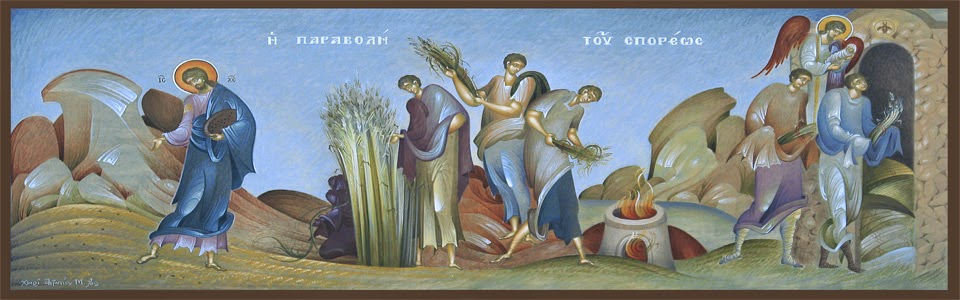
Sod of the Heart

Image
Icon by the hand of Antonios Fikos "And in his sowing, some fell along the road: and the birds came and ate it...[To] all hearing the word of the kingdom and not understanding, the wicked one comes, and snatches what was sown in his heart: this is the one sowed along the road."--Mt 13:4,19 The sowing of the seed in our hearts is not of our doing: what we have control over is what soil we have prepared.  The sower sows freely, and without His sowing our preparation of the soil is ineffective: "How can one believe without hearing?  And how can one hear without a preacher?"  Therefore we must prepare the soil of our hearts well, not letting it become like a road.  Hear what St. Cyril of Alexandria says: "A wayside is almost always hard and unbroken, because it is trodden down by the feet of all those who pass that way, and seed is never sown there.  No sacred or divine word, therefore, will be able to enter those who have minds that are hard and unyield...

The Spiritual Battle

Image
St. Nicodemus the Hagiorite "For not for us is the battle against blood and flesh, but against the rulers, against the authorities, against the worldrulers of the darkness of this age, against the spiritual hosts of wickedness in the heavenly places."--Eph 6:12 There has always been need for the faithful to do battle.  I do not mean physical battle, which God only commanded for a time, but spiritual battle.  Even in the Garden, Adam was called to fight against the serpent and failed, as one tradition views it.  So Satan and his demons have since then been lurking on the earth, "prowling like a roaring lion, seeking someone to devour."  Yet God has not abandoned us to the maw of the dragon: He gives us the grace to defeat the wicked one.  Christ trampled death by death, and He also trampled Satan and his power.  He Who cast out demons while on earth continues to cast them out when we call upon Him.  In the spiritual life, then, we are alwa...

The Family Annals

Image
    The Root of Jesse, or, Christ's Family Tree "For all who are led by the Spirit of God are sons of God."--Rom 8:14 The Holy Spirit that indwells in us is the Spirit of sonship by which God adopts us, by which He makes us members of His family.  If we are all sons of God, then we are all brothers and sisters of each other.  Whether we are Jew or Gentile by blood, by grace we have all become the brethren of the Jews.  For those not of direct bloodline to the Jews are a wild olive tree, and yet they have been grafted on to the cultivated olive tree, the tree of the Israelites.  So all who receive the Spirit are joined to the olive tree the Lord has cultivated since the Garden: all become of one family. = If we are all of the same family, then our family history is shared as well.  The Scriptures are a family history, a history of the family chosen and cultivated by God.  The history of the Old Testament is the history of the Jews by ra...

The Innumerable Facets of Scripture

Image
The Holy Prophet Jeremiah  "'Is not My Word like...a hammer that breaketh the rock in pieces?' (Jer 23:29).  As the hammer splits the rock into many splinters, so will a scriptural verse yield many meanings."--Sanhedrin 34A These words of the Jewish Midrash reveal an essential truth: the Light within the Scriptures is unfathomable.  Yet how much more incomprehensible is the fullness of the Lord! So many throughout the Church's life have reiterated the fact that Scripture bears a multitude of meanings.  Origen described three ways of interpreting Scripture: the way of the body, the way of the soul, and the way of the spirit.  In the West, the concept of four senses arose, as a medieval couplet summarizes it: "The Letter speaks of deeds; Allegory to faith; / The Moral how to act; Anagogy our destiny."  Some came to speak of the "sensus plenior," the fuller meaning that lay deeper than the literal meaning of the words themselves.  All t...

The Parasite of Curiosity

Image
A vice that was oft-discussed in olden times seems to have become eradicated today...at least in the popular mind.  I have heard and read very little in contemporary Christianity that discusses the vice of curiosity .  Yes, it is a vice when taken to an extreme (which it easily tends to): it is an excessive love of novelty that includes a disdain for what is older, more common, more traditional.  (Another meaning would be the curiosity of a busybody who is eager for gossip, but that form of curiosity seems more commonly condemned than this one.)  It may manifest as simply an overwhelming preference for living spiritual writers than sainted ones or for modern ideas over ancient ones; it may also manifest in an obsessive drive to be always learning more by learning broadly.  This latter form, I fear, is the least recognized and least condemned, and it is incredibly easy to fall into, especially with our current "Information Age."  In addition to the disdain ...