Posts

Showing posts with the label St. John Chrysostom

St. John Chrysostom: "It Is Not Enough to Leave Egypt: One Must Also Travel to the Promised Land"

Image
  It is not enough to escape evil, if we are to attain the kingdom of the heavens, but many works of virtue are needed. So that we might escape Gehenna, we must cleave from wickedness; so that we might attain the kingdom, we must cleave to virtue….Not doing good is a part of evil; for this is idleness, and idleness is a part of evil; rather, not a part, but the foundation and root of wickedness; for idleness has taught all evil...For to not do good is to do evil…. Because of this, the blessed Paul, too, leading us from wickedness, leads us towards virtue. For what is the use, tell me, of cutting away all the thorns, if you do not plant good seeds? For, the toil remaining incomplete, it turns again to our loss….He who does not weep does not, because of that, laugh, but he is in a middle state. So, too, here, he who is not bitter is not thereby good, nor he who is not wrathful thereby compassionate; but another effort is needed so that we might obtain the good. ...

The Family Annals

Image
    The Root of Jesse, or, Christ's Family Tree "For all who are led by the Spirit of God are sons of God."--Rom 8:14 The Holy Spirit that indwells in us is the Spirit of sonship by which God adopts us, by which He makes us members of His family.  If we are all sons of God, then we are all brothers and sisters of each other.  Whether we are Jew or Gentile by blood, by grace we have all become the brethren of the Jews.  For those not of direct bloodline to the Jews are a wild olive tree, and yet they have been grafted on to the cultivated olive tree, the tree of the Israelites.  So all who receive the Spirit are joined to the olive tree the Lord has cultivated since the Garden: all become of one family. = If we are all of the same family, then our family history is shared as well.  The Scriptures are a family history, a history of the family chosen and cultivated by God.  The history of the Old Testament is the history of the Jews by ra...

Glory to God for All Things

Image
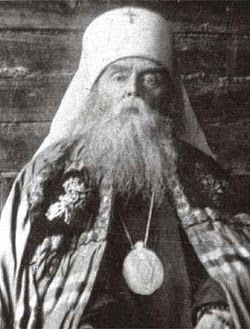
  Metropolitan Tryphon (1861-1934) "Oh, how many ideas and works had perished in that building--a whole lost culture?  Oh, soot, soot, from the Lubyanka chimneys!"--Aleksandr Solzhenitsyn In one of his most famous works, The Gulag Archipelago , the Russian author and Nobel Laureate in Literature Aleksandr Solzhenitsyn laments all the great works of human thought and culture that were destroyed by Soviet authorities.  The interrogators would burn many of the papers they found on the persons of their prisoners.   That was the fate of the Solzhenitsyn's own War Diary .  He mentions other such destructions: one man had formulated an alphabet and vocabulary for the Yeniseian languages, and with his work's annihilation came the removal of an entire nationality's written language for decades.  Another man was a great engineer, and his papers were taken from his wife and eradicated as well.  Solzhenitsyn's lament over the destruction of so much cultu...

"I Exorcise You, Spirit Unclean"

Image
  "I call upon You, God, Pantokrator, Lord Jesus Christ, Heavenly King: I call upon You, the maker of heaven and earth. I exorcise you, spirit unclean, according to the word of God, the maker of heaven and earth. Be put to flight by the one who wraps himself in light as a cloak: the one who alone has immortality and light unapprochable: to Whom be glory and power unto the ages. Amen." --St. Epiphanius of Salamis What St. Epiphanius' short prayer was written to do is something which the world has needed since the Garden: the exorcism of demons.  While sin is, of course, the choice of man, the demons play their part in trying to bend us toward sin, to constantly bombard us with temptation (think of C.S. Lewis' fictionalized account of this in The Screwtape Letters ).  But God does not leave us to their whims: we are not abandoned into the hands of the "worldrulers," as St. Paul calls them.  Indeed, He gives us the power of His Spirit to d...

The Holiness of the Name

Image
"When the priests and the people which stood in the Temple Court heard the Expressed Name come forth from the mouth of the High Priest, they used to kneel and bow themselves and fall down on their faces and say, 'Blessed be the name of the glory of his kingdom for ever and ever!'"-- Yoma 6:2 For many cultures throughout the world, a name is a powerful thing.  It was no different for our forefathers in faith, the sons of Israel, for to them had been revealed the Holy Name of God.  His Name was seen to be so powerful that only the high priest could pronounce it, and that only once a year.  The Name was so great and so holy that Jews to this day do not pronounce it when reading the Scriptures, instead only saying "Adonai" (Lord).  For the holiness of God is an immense flood that soaks everything relating to Him, so that from the Ark of the Covenant to the Holy Name, all is imbued with His sanctity.  And this sanctity is of such a power that the one wh...

The Innumerable Facets of Scripture

Image
The Holy Prophet Jeremiah  "'Is not My Word like...a hammer that breaketh the rock in pieces?' (Jer 23:29).  As the hammer splits the rock into many splinters, so will a scriptural verse yield many meanings."--Sanhedrin 34A These words of the Jewish Midrash reveal an essential truth: the Light within the Scriptures is unfathomable.  Yet how much more incomprehensible is the fullness of the Lord! So many throughout the Church's life have reiterated the fact that Scripture bears a multitude of meanings.  Origen described three ways of interpreting Scripture: the way of the body, the way of the soul, and the way of the spirit.  In the West, the concept of four senses arose, as a medieval couplet summarizes it: "The Letter speaks of deeds; Allegory to faith; / The Moral how to act; Anagogy our destiny."  Some came to speak of the "sensus plenior," the fuller meaning that lay deeper than the literal meaning of the words themselves.  All t...

The Fast of Intercession

Image
  "Not such a fast I have chosen, says the Lord, but loose all bonds of iniquity, separate knots of violent covenants, send forth the shattered in release and all wicked contracts tear asunder."--Is 58:6 When we fast, we are not to merely refrain from food, though it is praiseworthy to do so to control our passions and offer our sacrifices to God; we are also to do good to our neighbor, as the Spirit spoke through the prophet Isaiah.  We are to fast from wickedness and fast for good, for the more exact fast, the true fast, is to abstain from sin, as St. John Chrysostom remind us, and while we abstain from sin we should also actively do good; thus the Lord directs us to do good for our neighbor during our fasts, expanding the normal definition of almsgiving, calling us to all of the corporal works of mercy.  Yet, are there not other ways we can assist our neighbor during the Fast, in addition to the physical assistance?  If we do not have a brother bound in wic...

Lectio Divina

"Oh, how I love Thy Law! It is my meditation all the day." So sung King David, and so should we sing at all times in our fervor for the Lord's Word. Many ways are there for us to be soaked in Scripture in order to "swim in the Law of the Lord" (in the beauteous phrase of St. Seraphim), and one of these is the way known as lectio divina, the divine reading. A great guide of this practice is Guigo II, a Carthusian prior. Let us learn from him how the Law of the Lord can always be our delight. Guigo shows us for degrees for entering into the inner chamber of the Word: reading, meditation, prayer, and contemplation. We can even see these in the Psalms: "Make me understand the way of Thy precepts, and I will meditate on Thy wondrous works...I long for Thy salvation, O Lord, and Thy Law is my delight." Guigo's words show us how these verses are a lamp for our path into the Scriptures: "Reading is the careful study of the Scriptures, conce...