Posts

"I Exorcise You, Spirit Unclean"

Image
  "I call upon You, God, Pantokrator, Lord Jesus Christ, Heavenly King: I call upon You, the maker of heaven and earth. I exorcise you, spirit unclean, according to the word of God, the maker of heaven and earth. Be put to flight by the one who wraps himself in light as a cloak: the one who alone has immortality and light unapprochable: to Whom be glory and power unto the ages. Amen." --St. Epiphanius of Salamis What St. Epiphanius' short prayer was written to do is something which the world has needed since the Garden: the exorcism of demons.  While sin is, of course, the choice of man, the demons play their part in trying to bend us toward sin, to constantly bombard us with temptation (think of C.S. Lewis' fictionalized account of this in The Screwtape Letters ).  But God does not leave us to their whims: we are not abandoned into the hands of the "worldrulers," as St. Paul calls them.  Indeed, He gives us the power of His Spirit to d...
The Catholicity of the Saints

Image
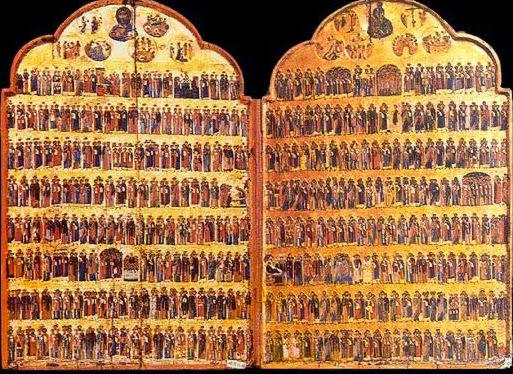
A Hagiologion (calendar of all the saints by feast day) from St. Catherine's Monastery on Mount Sinai (13th century) "Resplendent with the brightness of beauty, and shining as unerring stars, you have made the Church of Christ a star-filled heaven on earth by the diversity of your lives."--Canon of the Sunday of All Saints, Ode 3 The many mansions in the Father's house welcome countless men and women from every land and tongue, every tribe and nation, every race and people.  Until we, God willing, are also there, we can never know the sheer number of those who have fallen asleep marked with the sign of faith, the multitude of those who are praising the Lord for eternity.  For though there are thousands and thousands of the Lord's servants that we know are in Heaven, there are innumerably more as well whom we shall not know in this life. These saints in Heaven, even the ones we do not glorify with that title, come from countless backgrounds.  Some are ...

Rest in Capernaum

Image
  Root of Jesse icon by Michael Damaskinos (1530/5-1592/3), showing Christ and His forefathers and earthly brethren "After this He went down unto Capernaum, He and the mother His, and the brothers His, and the disciples His: and there they stay not many days."--Jn 2:12 Between the Lord's first sign at Cana in Galilee and His cleansing of the Temple during His first Pascha during His public ministry, John the Theologian recounts this simple trip to Capernaum.  No more details are given except who went and that they did not stay long.  What can we learn from this short passage? John may have recorded this event to show us our Lord's need to rest, as He is man as well as God.  There is no record that He preached to the crowds or healed the sick during this time, and it was only a few days: perhaps it was a rest before Pascha.  Since it was before Pascha, maybe it was a form of Lent, a preparation for the pending Feast.  Another possibility, though...

The Apostles of the Cross

Image
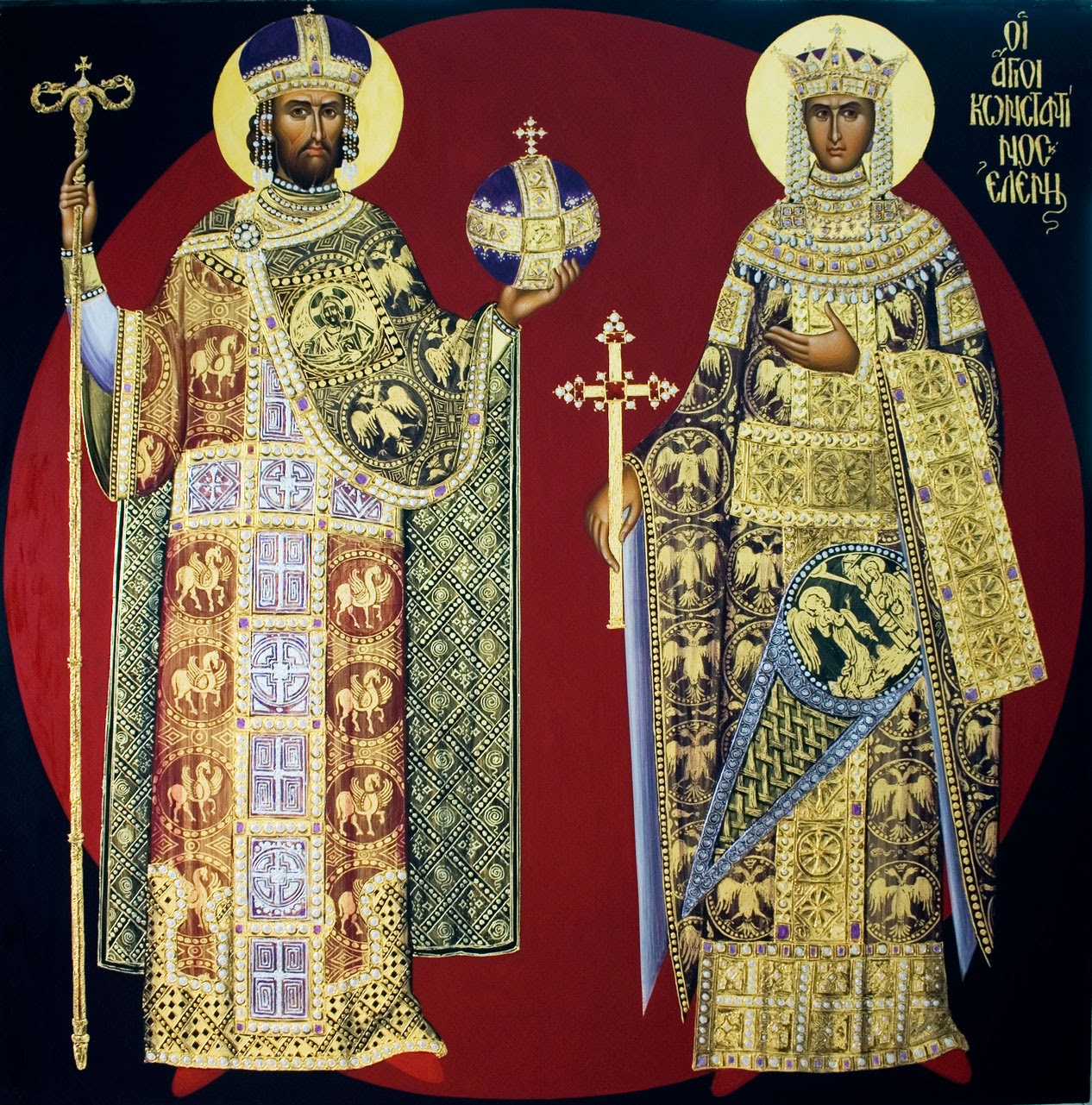
"We though preach Christ crucified, to the Jews indeed a scandal, but to the Greeks folly..."--1 Cor 1:23 Christ is risen!  He Who was crucified for our sins has trampled death and risen again, and yet still the Cross is His sign.  By His Resurrection great power was given to the Cross, and it is for this that Constantine heard: "By this sign you will conquer."  And today we celebrate St. Constantine and his mother Helena, apostles of the Cross. We laud these two saints as "Equals to the Apostles."  Why do we do so?  Because of their immense effect in spreading the Gospel throughout the world.  On those who devotedly gave themselves to the apostolic duty of evangelization, we bestow this title, as we do to Mary Magdalane and Sts. Cyril and Methodius.  What did Constantine and Helena do to earn this title? Constantine was the Roman Emperor, and, like most Emperors, he was a pagan.  Yet as he prepared for a battle with his usurper, Const...

We Are Men, Not Gods

Image
Cornelius Falls to His Knees before St. Peter and Worships Him  (1582) by Philips Galle (1537-1612) "Arise: I myself am a man."--Acts 10:26 Christ, the Crucified and Risen One, the Author of Life, is both God and man, two natures united without division or confusion or admixture.  Christians, though, even when divinized, are still men.  Holiness can lead to confusion on this matter, as it did when Cornelius fell on his feet and reverenced the Holy Apostle Peter, who had to remind him, "I myself am a man."  Even worse happened to Barnabas and Paul, when the priest of Dios almost led the crowd to offer bulls and wreaths to them in sacrifice, and they had to tear their cloaks and cry out, "Men, what things do you do?  For we are men of like passions to you." As Christians, we have the All-Holy Trinity dwelling within us from our Baptism, when we partook of the living water Jesus prophesied of to St. Photina, the Samaritan woman.  Yet even thou...

A Christian's Task

Image
Holy Prophet Micah "He has showed you, O man, what is good; and what does the Lord require of you but to do justice, and to love kindness, and to walk humbly with your God?"--Mic 6:8 A Christian's task is simple: to love God with his entirety, and to love his neighbor as himself.  All other duties and tasks in the Christian life derive from these two.  As the Lord Himself said, "On these two commandments all the law and the prophets are suspended."  We must always return to these two commandments as we navigate our way through the stormy seas of earthly life. God calls each of us to be Christian in a particular way, and He lays out a path for each of us, a particular path.  It is in fulfilling this particular path that each of us can honor God most perfectly.  Even if one way of life is objectively greater than another, it does not mean that it is better for each Christian to follow the greater way if he is not so called.  One of the great...

Exodus and Entering

Image
The Portaitissa "The Lord will keep your going out and your coming in from this time forth and for evermore."--Ps 120:8 The blessings of the Lord are manifold, manifest and hidden, in an infinite myriad of places, times, and circumstances.  We are called to bless the Lord at all times, for He is the One Who first blesses us at all times, in all of our doings.  The Lover of Mankind loves us so much that He loves us in every time, and He wishes our good.  When we ask Him to bless us in all our doings, even with the simple prayer, "Lord, give Your blessing," we are merely asking Him to act on the love He already has for us; we are pleading the loving Father to continually love us as He already does. Among the various times He blesses us are when we go out and come in at all times.  The psalm says it well: in the Greek, He keeps every exodus and eisodus (entering) of ours.  We can see in the history of salvation how He guarded the exodus and entering of...