Posts

Showing posts with the label Cross

A Drop of Pascha to Sweeten the Fast: The Canon of the Third Sunday of the Great Fast (Veneration of the Cross)

The Canon for the Third Sunday of the Great Fast , the Sunday of the Veneration of the Cross, comes as a shock.  We know Sundays are always mini-Paschas, celebrations of the Resurrection, even in the depths of the Fast. (So they always have full canons, rather than the penitential three-ode canons found during weekdays, for which the  Triodion  is named.)  We have continued to sing the resurrectional hymns from the Octoechos throughout the Fast.  Yet the Canon for this week hits us with unbridled Paschal joy, for the ikoi come from the great Paschal Canon that we gloriously shout out during Paschal Matins. The Cross is the great reverser: through the Cross, a Person bearing the deathless divine nature dies; through the Cross, we deathbound men gain deathlessness. So perhaps we should not be surprised that the Cross brings a burst of joy in the middle of the somber Fast, just as its feast on September 14 is a day of fasting n the midst of the year's longest gap b...

John W. Lynch: "The Cross and the Crib"

 Introduction John W. Lynch, S.M. (1904-1970) was a priest, poet, and author; he lived and served in New York.  His most famous work is a long poem about Mary, A Woman Wrapped in Silence (1941), which I discussed in an article years ago ( "Expanding the Narratives of Scripture" ).  He wrote many other poems, which seem to be mostly scattered in journals and newspapers, or stuffed into his prose books, as well as a long poem on the life of Christ, This Little While , a companion to A Woman Wrapped in Silence .  (A portion of This Little While , "The Crucifixion," can be found here: Part 1 , Part 2 , Part 3 ).   Among his prose works are Bernadette: The Only Witness , The Deed of God , and  Hourglass: Stories of a Measured Year .  This last book is a mixture of short reflections, poems, and stories loosely arranged across the course of the Church year.  Below is one of those reflections, on the connection of the Nativity and the Passion, a th...

St. John of Ávila (?): "Moves Me Not, My Lord, to Love You"

One of the greatest mystical poems of the Spanish Golden Age is the anonymous "Sonnet to Christ Crucified."  At one time or another, it has been attributed to practically every important spiritual writer of the time; one of the strongest cases is for St. John of Ávila (1500-1569), as some lines in his authentic works come very close to the themes and language of the poem. Over a decade ago , I posted the Spanish text and an English translation: the translation was off in a few spots, and it certainly did not flow as a poem.   The translation below certainly wouldn't pass scansion as a traditional English poem, and i have forgone attempts to match the Spanish rhyme scheme, but I think it has a rhythm of its own, and it gives a much better sense of the original poem than my translation a decade ago.  The odd syntax (where the verb "move" comes before its varied subjects) reflects the syntax of the Spanish original. Moves me not, my Lord, to love You the Heaven Yo...

Paul Claudel: "The Crucifix"

  Introduction Paul Claudel (1868-1955) was a French playwright and poet, known for his devout Catholicism and how it affected his poetry.  The following diptych, "The Crucifix," first appeared in his 1916 collection Other Poems During the War .  The original poem consists of long lines that rhyme in couplets; my translation is instead in a kind of ballad meter: alternating tetrameters and trimeters rhyming ABCB.  Each two of my lines reflects one of Claudel's lines, so the rhymes are still in equivalent relation. The Crucifix Paul Claudel His Head Seen From the Right Of all the Body crucified,     only Head is free. The thorns they’ve wrapped around, with care,     mean no support can be. Three hours it has reigned and prayed;     three hours we’ve seen God’s Face. In the end, the Head must fall     when force has left His frame. Behold! the moment has arrived     that patient we’ve awaited. ...

A Coptic Litany to the Cross

Image
  Hail to you, Cross,  joying of Christians!  Hail to you, Cross,  crushing of tyrants!  Hail to you, Cross, firming of faithful! Hail to you, Cross, comfort of faithful! Hail to you, Cross, firming of martyrs! Hail to you, Cross, victory's weapon! Hail to you, Cross, throne of the King! Hail to you, Cross, sign of salvation! Hail to you, Cross, O shining light! Hail to you, Cross, sword of the Spirit! Hail to you, Cross, fountain of grace! Hail to you, Cross, storehouse of goods! Hail to you, Cross, to age upon age!   Nota Bene: This litany is adapted from a Coptic liturgical text; see Service of the Deacons: Rites and Hymns of the Liturgies and Services of the Coptic Orthodox Church (Coptic Orthodox Diocese of the Southern United States, 2010), 255-256.   Adaptation ©202 4 Brandon P. Otto .  Licensed via CC BY-NC.   Feel free to redistribute non-commercially, as long as credi...

Jacques Lobbet de Lanthin: The Cross of Christ Is a Bow

Introduction  To describe Fr. Lobbet, I can do no better than quote a Belgian biographical dictionary: "Lobbe de Lantin ( Jacques ), ecclesiastical writer and theologian, born at Liège, the 28th of September, 1592, died in that town, the 18th of June, 1672.  He entered the novitiate the 18th of October, 1613, taught philosophy at Douai, and was later rector of the colleges of Tournai, of Mons, and of Liège.  His domain was moral theology, where he was distinguished by his great surety of method."  (The dictionary fails to note that he was a Jesuit.)  The dictionary lists fifteen volumes of works, most about sin or moral questions, and a few more general moral works ( The Way of Life and Death , On Christian Fortitude and Constancy ), as well as a screed titled Temple of the Lord, or, On the Religious Worship of Temples, Against the Petulant License of This Age .  The selection below is from Lobbet de Lanthin's Treatise on the Sacred Passion and Cross of Chr...

Francisco López de Zárate: "The Raising of the Cross"

 Introduction Francisco López de Zárate was born in Logroño, in northern Spain, the son of a postman. He first began studying Law at Salamanca, in 1598, but abandoned his studies to join the army, fighting in Flanders, Italy, and Germany. After his military service, he served as secretary of state for the Duke of Lerma, though his austere moral character did not fit in well with political intrigue. While based in Madrid, he often retired to Logroño for a calm spot to write. He wrote both poems and dramas, and was praised by great writers of his day like Lope de Vega (1562-1635) and Miguel de Cervantes Saavedra (1547-1616). Not long after writing his Poema heróico de la invención de la Cruz , in 1648, he suffered a stroke and remained paralyzed on his right side for the rest of his life. He died on Madrid, on March 5, 1658. Though praised by writers of his day, known as "the Cavalier of the Rose," after one of his sonnets, he is little-known now. He wrote many...

The Apostles of the Cross

Image
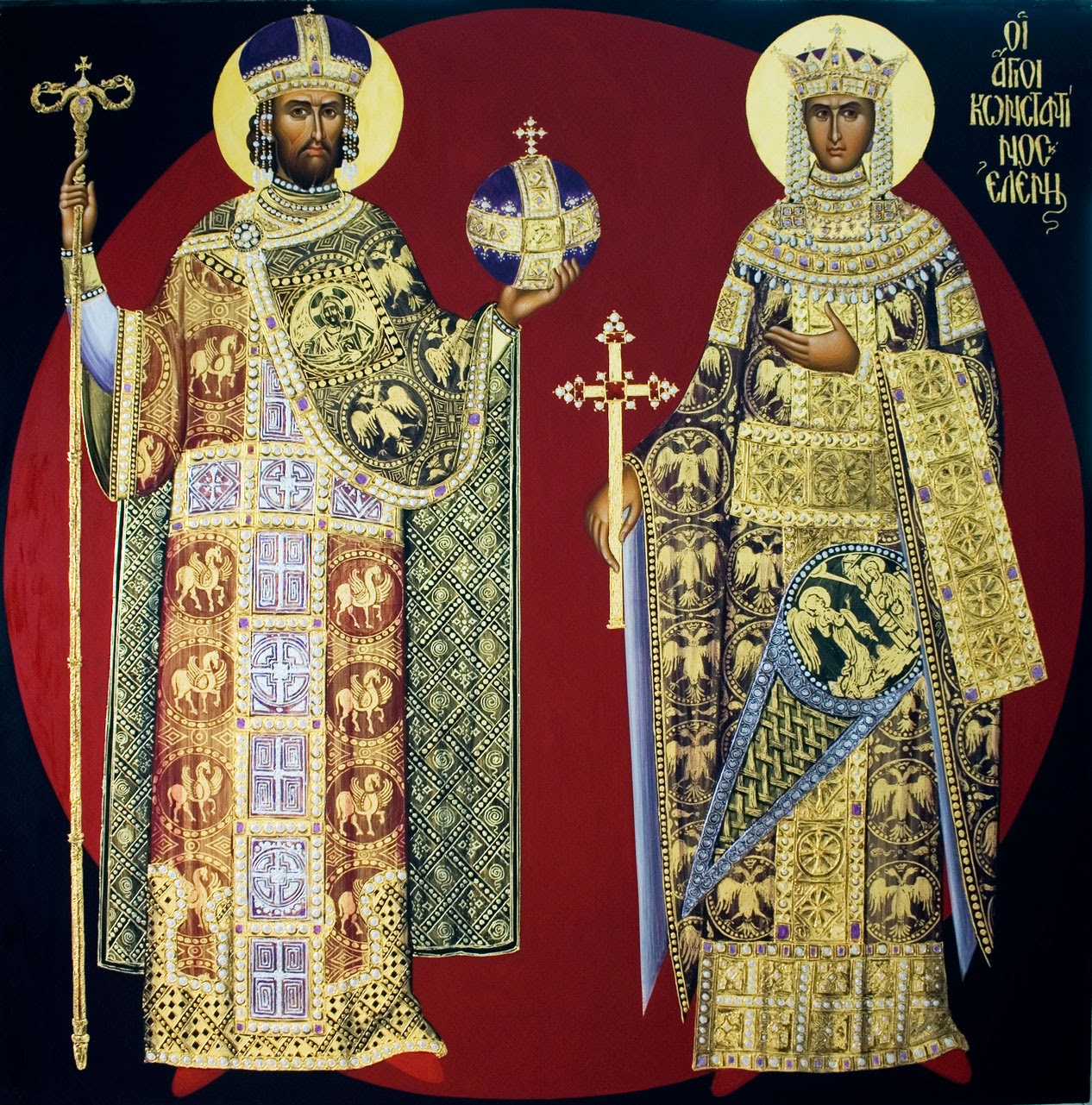
"We though preach Christ crucified, to the Jews indeed a scandal, but to the Greeks folly..."--1 Cor 1:23 Christ is risen!  He Who was crucified for our sins has trampled death and risen again, and yet still the Cross is His sign.  By His Resurrection great power was given to the Cross, and it is for this that Constantine heard: "By this sign you will conquer."  And today we celebrate St. Constantine and his mother Helena, apostles of the Cross. We laud these two saints as "Equals to the Apostles."  Why do we do so?  Because of their immense effect in spreading the Gospel throughout the world.  On those who devotedly gave themselves to the apostolic duty of evangelization, we bestow this title, as we do to Mary Magdalane and Sts. Cyril and Methodius.  What did Constantine and Helena do to earn this title? Constantine was the Roman Emperor, and, like most Emperors, he was a pagan.  Yet as he prepared for a battle with his usurper, Const...

The Cross, Icon of Christ's Love

Image
 "When you see the cross, know and believe that you are seeing Christ enthroned on it; when you pray before the cross, believe that you are doing so concerning Christ our God and not with inanimate matter. For it is Christ Who receives the veneration you offer before the cross; and it is He Who hears the supplications of your mouth and fulfills the desires of your heart, which you ask with faith. Whoever does not honor the cross, or insults it, insults Christ Himself."--St. Nerses Shnorhali We are to preach nothing except Christ Crucified, following the example of Paul: on the Cross Christ bore our iniquities.  He was lashed, stripped, beaten, plucked, mocked, and finally forced to carry His death-wood to the Place of the Skull, where men of hubris dared to kill the Almighty Author of Life.  Yet He did this willingly!  It is this which changes the Crucifixion from merely a horrific deed of men into an infinitely loving act of God.  For it was God Who deign...