Posts

Showing posts with the label icons

Icons: The Eyes of God (1988) | Sampaolo Films / St. Paul Video

Image
I've been digitizing some old Catholic (and other) VHS tapes, and I found this interesting little documentary about iconography in Macedonia: Icons: The Eyes of God (1988), produced by Sampaolo Films and published by St. Paul Video.  As it seems to be no longer available for sale, I have uploaded it to YouTube to make it available for others to view. Below is the description from the back of the case:   "Icons are among the most intricate and rich artworks in the Church. The beauty of these sacred images has awakened in people of both East and West a sense of faith and awe.  'Icons: The Eyes of God' brings you to Macedonia, the southernmost republic of Yugoslavia, a centuries-old cross-roads between East and West. From here come the Terracotta icons of first century Christianity; the resplendent colorful images of the Middle Ages—Byzantine in style; and frescoes of various churches—precursors to Giotto's style—which miraculously survived the period of Moslem dom...

Iconic Icon Supplements: The Symbols of Icons

Image
  Icon of Our Lady of Mount Carmel (Mother of Carmel) by the Sisters of Our Lady of Mount Carmel, Terre Haute, IN One of the biggest difficulties Western Christians have in appreciating icons is a lack of understanding.  I have previously discussed some of the theology behind iconography, but in this post I will discuss another big difficulty: the symbolism of iconography.  Even if one can understand the theology of the icon and why one should venerate it, it is still difficult to venerate something that seems to be such a strange mess of non-understood symbols.  This post will hopefully clear up some of that difficulty so that others can better understand icons and venerate them more worthily. Monograms The language used in iconography is often difficult by itself, since it is usually written in either Greek or Russian, often with a strange script that combines letters on top of each other or uses less common forms of letters.  Even after getting past...

Our Holy and God-Bearing Fathers: St. John of Damascus

Image
 St. John of Damascus (676-749), also known as St. John Damascene or Chrysorrhoas ("streaming with gold"), served as Chief Councilor ( Protosymbullus ) of Damascus under Muslim rule before later retiring to live the monastic life in the Monastery of St. Sabbas near Jerusalem.  He was a prolific writer whose work was incredibly influential, even to this day.  A particularly important note about his work was his exposition of the theology underlying icons: his work was thus key to the Seventh Ecumenical Council, Nicea II (787).  The Eastern Church often refers to him as "the last of the Fathers," and he is a Doctor of the Church often referred to as the Doctor of the Assumption.  His feast day in both the Western and Eastern Churches is December 4, though from 1890-1969 it was celebrated on March 27 in the Western Church. St. John was brought up under Muslim rule in Damascus, where his strong Christian family held high hereditary public office under the cali...

Iconic Icons Supplement: Icons of the Trinity

Image
In celebration of Trinity Sunday in the Western Church today, I decided to write a short post on the history of artistic representation of the Most Holy Trinity, especially in the East. Nowadays, there are many representations of the Trinity showing the Three Persons as an old man (the Father), Jesus Christ, and a dove (the Holy Spirit).  Before these were in vogue, the Trinity was often depicted symbolically (especially in the Western Church) in forms such as a triangle-encased All-Seeing Eye (a symbol adapted and Christianized from ancient Egyptian symbolism that is, sadly, now usually connected with Freemasonry).  In the earliest days of the Church, though, there were no representations of the Trinity apart from the Second Person Incarnate. Eye of God , Mission San Miguel, California (19th century) Why was this?  One main reason was the theological reasoning behind having any images of God in the first place.  The Pentateuch declares that we shall ha...

Iconic Icons: The Ascension

Image
  Ascension Icon by Andrei Rublev (late 14th - early 15th century). The Ascension of Our Lord Jesus Christ is traditionally celebrated, following the detail of Acts 1:3, on the Thursday 40 days after Pascha (Easter), which was last Thursday, though most Latin Rite dioceses (at least in the U.S., if not in other countries as well) transfer the celebration of this feast to the next Sunday, which is today.  In Greek, this feast is called 'Η Αναληψις : analepsis means a "taking up," although the term is used in narrative analysis (of films, novels, and other works) to indicate a flashback.  The events of this feast are outlined in Mark, Luke, and Acts: "So then the Lord Jesus, after He had spoken to them, was taken up into Heaven, and sat down at the right hand of God" (Mk 16:19). "Then He led them out as far as Bethany, and lifting up His hands He blessed them.  While He blessed them, He parted from them, and was carried up into Heaven" (...

The Rosary and the Komboskini

Image
Each Wednesday during the school year, I pray a Rosary with a spiritual brotherhood I am a member of, a Rosary that is often prayed during a procession led by an icon of Our Lady of Czestochowa.  This past week, as I prayed with my rosary in my right hand and my komboskini around my left wrist, I thought of the sublime combination of traditions. On one hand, we were praying the Rosary, the traditional Marian prayer revealed to St. Dominic.  With this prayer, we fervently beseeched the intercession of Our Lady, the Mother of God, as we meditated upon the mysteries of the life of Our Lord.  On the other hand (quite literally), my komboskini wrapped around my wrist reminded me to constantly remember Jesus Christ and to pray unceasingly the Jesus Prayer: Lord Jesus Christ, Son of God, have mercy on me, a sinner.  The Rosary is a traditional devotion of the Western Church, and the Jesus Prayer prayed on a komboskini is a traditional devotion of the Eastern Church....

Iconic Icons: 'Η Αναστασις (The Resurrection)

Image
Anastasis icon dated 1315 from the Church of the Holy Saviour in Chora in Istanbul, Turkey   Χριστος ανεστι!  Christ is risen!  (And you, of course, are responding, "Αλειθος ανεστι!  Truly He is risen!")  Today (for those following the calendar of the Catholic Church) is Pascha (Easter, for most English speakers), the most holy day of days, the feast of feasts, the day of the Resurrection of Our Lord Jesus Christ.  Today is the true Passover, when Christ passed over from death to life, and because of this it truly bears the name Pascha ("Passover" in Greek).  To celebrate this miracle of miracles, the Eastern Church has a festal icon of Christ's Resurrection, just as they have icons for various other feasts. The icon of Pascha is 'Η Αναστασις , The Resurrection.  (Etymologically, anastasis literally means "standing again," combining ana (again) and stasis (standing).)  Though there are multiple Paschal icons, this is the most promin...

Iconic Icons Supplement: Ethiopian Icons

Image
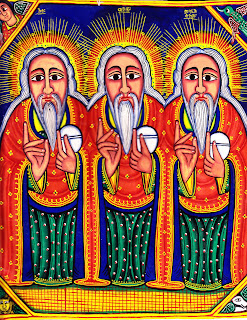
Like almost any product of man, icons contain differences depending on the culture in which they were made (besides even more differences from individual artists).  Thus among icons, there are different styles relating to the different cultures of origin: Greek (Byzantine), Russian, Coptic, Ethiopian, etc.  Usually in my posts, I include and discuss Byzantine icons, though Russian icons are also involved often.  In this post, I wish to give a brief overview of another style of icons: Ethiopian iconography. The Ethiopian Orthodox Church began when Christianity was first widely spread to Ethiopia (discounting the Ethiopian eunuch converted by St. Philip in Acts 8) in the 5th century by a group of missionaries known now as the Nine Saints: Abba Aftse, Abba Alef, Abba Aragawi, Abba Garima (Isaac/Yeshaq), Abba Guba, Abba Liqanos, Abba Pantelewon, Abba Sehma, and Abba Yem'ata.  It is conjectured that they were possibly refugees from persecutions after the Council of Cha...

Iconic Icons Supplement: Our Lady of Guadalupe

Image
"Am I not here, I, who am your mother?" I must apologize for taking so long to write about Our Lady of Guadalupe (Nuestra Señora de Guadalupe): though her image is not an icon in the typical sense (that is, made by human hands for the purpose of connection to Christ or the saints in Heaven), it most definitely should be classified as an acheiropoieton (an sacred image not made with human hands).  I apologize for not including it in my original post on these images: it didn't enter my mind until much later.  This post, then, is a supplement for my post on the acheiropoieta . St. Juan Diego (1474-1578) was a Native American from what is now Mexico (his birth name was Aztec: Cuauhtlatoatzin).  Originally a mystical and devout pagan, around 1520 or so he converted to Christianity, taking the name Juan Diego.  Shortly thereafter, in 1529, he became a widower, yet his faith remained strong.  It was in 1531 that the events for which he is now known began...

Iconic Icons: Axion Estin

Image
The original icon  The original icon without its riza (the metal covering revealing only the faces) The Axion Estin (Αξιον εστιν), "It is truly meet," is an icon of the Theotokos (Eleusa-style) located in the the Protaton, a church in the Karyes settlement of the famous Mount Athos in Greece, home to many ancient monastic communities.  The event which the icon takes it name from occurred in 980, so the icon was written sometime before then. The name of the icon comes from the opening words of a Marian hymn in the Divine Liturgy of St. John Chrysostom.  Up until this famous event, the hymn only included the latter half, starting at "More honourable than the Cherubim," which was written in the late 700s by St. Cosmas the Hymnographer, foster-brother of St. John Damascene.  This section of the hymn reads thus: More honorable than the cherubim, and beyond compare more glorious than the seraphim. Without corruption thou gavest birth to God the Wo...