Posts

"Is it possible, my life, that I caused you such evil?": A Spanish Lenten Hymn

Image
Félix Lope de Vega was a famous poet and playwright of the Spanish Golden Age, most well-renowned for his sonnets.  Among his prolific works (Cervantes called him "Monster of Nature" for the sheer volume of them) are many religious poems.  Below is one such poem, which Spanish-speakers sometimes use as a Lenten hymn. "Soliloquio - III -" Manso Cordero ofendido,  puesto en una cruz por mí,   que mil veces os vendí  después que fuiste vendido.  Dadme licencia, Señor,  para que, deshecho en llanto,  pueda en vuestro rostro santo  llorar lágrimas de amor.  ¿Es posible, vida mía,  que tanto mal os causé,  que os dejé, que os olvidé,  ya que vuestro amor sabía?   Tengo por dolor más fuerte  que el veros muerto por mí  el saber que os ofendí,  cuando supe vuestra muerte.  Yo os amo, Dios soberano,  no como Vos merecéis,  pero cua...
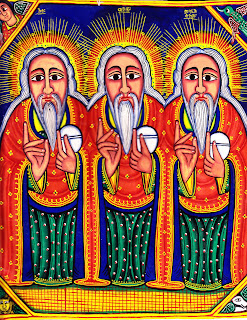
Iconic Icons Supplement: Ethiopian Icons

Image
Like almost any product of man, icons contain differences depending on the culture in which they were made (besides even more differences from individual artists).  Thus among icons, there are different styles relating to the different cultures of origin: Greek (Byzantine), Russian, Coptic, Ethiopian, etc.  Usually in my posts, I include and discuss Byzantine icons, though Russian icons are also involved often.  In this post, I wish to give a brief overview of another style of icons: Ethiopian iconography. The Ethiopian Orthodox Church began when Christianity was first widely spread to Ethiopia (discounting the Ethiopian eunuch converted by St. Philip in Acts 8) in the 5th century by a group of missionaries known now as the Nine Saints: Abba Aftse, Abba Alef, Abba Aragawi, Abba Garima (Isaac/Yeshaq), Abba Guba, Abba Liqanos, Abba Pantelewon, Abba Sehma, and Abba Yem'ata.  It is conjectured that they were possibly refugees from persecutions after the Council of Cha...

Litany for Persecutors

Image
I vilify persecutors.  I must admit that this is a habit I have, and one that I have trouble breaking.  When I hear of Kathleen Sebellius and the HHS contraceptive mandate, I vilify Ms. Sebelllius.  When I hear of attacks on Nigerian Christians by Boko Haram, I vilify militant Muslims.  Now, I don't say that they are going to hell: I know I can't judge that at all.  Though I sometimes speak in generalizations (such as just talking about "Muslims" when I discuss teachings of the Qur'an made prominent by militant groups or "Jesuits" when I discuss the many heretical teachings of individual Jesuits throughout the past few decades), I know that they're generalizations: not all Muslims want to kill me or subdue me with a jizya , and not every Jesuit is a Resurrection-denying, "historical Jesus"-promoting heretic.  Yet I have this terrible habit of vilifying those who commit manifest evil acts, particularly high-profile ones that they seem proud...

Make A Little Tabernacle in Your Soul

Image
In the very start of those strange, exotic, "eXtreme" days known as the '90s, a quirky little band called They Might Be Giants released a nigh-nonsenical song entitled "Birdhouse in Your Soul" (paired with an incomprehensible video).   The song is sung from the point of view of a nightlight in the shape of a blue canary belonging to what seems to be a very lonely child.  The aforementioned nightlight asks the child, in the chorus, to "make a little birdhouse in your soul," so that the child will carry the memory of the luminous bird wherever he goes. While having a birdhouse in our souls would not be conducive to the spiritual life (unless you think of it as a birdhouse for housing the Holy Spirit in the form a dove), what would be conducive is a tabernacle.  The concept of keeping a perpetual space for the Lord within our hearts is one I wrote about before, in my post on the teachings of Ven. Clara Fey .  She wrote, "Our Lor...

A Theologian's Renunciation

Image
Though I hesitate to take on the title, by my studies, I think I must be classed as a theologian.  Yet with the trends popular among many who bear the title "theologian," I sometimes recoil at the very name itself.  I have thought about these positions and ideas that many theologians hold dear to their hearts (or dear to their intellects).  It is with a strong heart, a sound mind, and a firm will that I renounce these opinions.  I declare: I renounce renouncing the Father.   Though, it is true, God is beyond gender, the First Person of the Trinity revealed Himself under the title of Father: who are we to renounce that title? I renounce renouncing the Son.   Jesus Christ is the Son of God, one divine Person in two natures, human and divine.  The Councils stated it, and I confess it: anything else is heresy. I renounce the Spirit's domination.   The Holy Spirit is God, the Third Person of the Most Holy Trinity: this I affirm.  The Father a...

"Pray for me, my friends, who have not strength to pray."

Image
My girlfriend's grandmother died last night, and I have been praying for her soul.  We are called to pray for the dead in general, for they cannot pray for themselves once they have passed, and we usually especially pray for those who are close to us. One way I pray for the souls of the faithful departed is by listening to a musical setting of a Requiem Mass, the beautiful prayers of the Church for all her departed children.  While listening, I pray for the recently deceased (I often do this whenever someone I know dies).  While I have a soft spot in my heart for the works of the famous Czech composer Antonín Dvořák, the setting I usually pray with is the setting by the famous Italian opera composer Giuseppe Verdi.  Though Verdi was an atheist, he felt inspired by the sacred prayers of the Church found in the Requiem Mass, and his recently-deceased friend Alessandro Manzoni (a poet and novelist famous for The Betrothed ) was Catholic, so he felt inspired to compos...

Iconic Icons Supplement: Our Lady of Guadalupe

Image
"Am I not here, I, who am your mother?" I must apologize for taking so long to write about Our Lady of Guadalupe (Nuestra Señora de Guadalupe): though her image is not an icon in the typical sense (that is, made by human hands for the purpose of connection to Christ or the saints in Heaven), it most definitely should be classified as an acheiropoieton (an sacred image not made with human hands).  I apologize for not including it in my original post on these images: it didn't enter my mind until much later.  This post, then, is a supplement for my post on the acheiropoieta . St. Juan Diego (1474-1578) was a Native American from what is now Mexico (his birth name was Aztec: Cuauhtlatoatzin).  Originally a mystical and devout pagan, around 1520 or so he converted to Christianity, taking the name Juan Diego.  Shortly thereafter, in 1529, he became a widower, yet his faith remained strong.  It was in 1531 that the events for which he is now known began...